
One month ago, United Way of Greater Houston and Patient Care Intervention Center (PCIC) launched the Integrated Client Journey (ICJ) Self-Service portal—a new way for Houstonians to set goals, find help, and work toward financial stability at their own pace.
The launch is more than a tech milestone. It’s a response to a very specific problem in Greater Houston: thousands of households are working hard and still can’t consistently cover the basics.
The ALICE Reality in Greater Houston
United Way of Greater Houston uses the ALICE framework—Asset Limited, Income Constrained, Employed—to describe households that earn above the federal poverty level but still struggle to afford essentials like housing, food, child care, health care, and transportation.
In Greater Houston:
- 14% of households live below the federal poverty threshold, and
- another 28% are ALICE households—working, but unable to consistently meet basic needs.
That means roughly 4 in 10 households in the region are either in poverty or on the edge of it. (Source: United Way of Greater Houston)
These are people you see every day: child care workers, cashiers, home health aides, office staff. Many are juggling multiple jobs and caregiving responsibilities, and they often face impossible choices—pay the rent or fix the car, buy groceries or pay for child care. The ALICE data underscores why United Way has doubled down on strategies that do more than meet immediate needs—they help people chart a path toward long-term financial stability.
ICJ Self-Service is designed to be a centerpiece of these strategies.
What is ICJ Self-Service?
The Integrated Client Journey (ICJ) is United Way of Greater Houston’s strategic direction—called “Our Approach”—to help individuals and families move from crisis to stability and stay there. This work focuses on neighbors living as ALICE or below across United Way’s four-county service area: Fort Bend, Harris, Montgomery, and Waller counties.
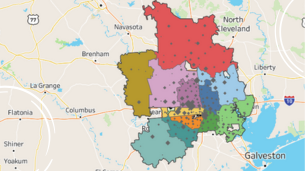
Through ICJ, clients can set goals, connect to funded partners across multiple service areas, and access support over time. The ICJ operates across 12 priority regions in these four counties, creating a coordinated network of services for households working toward financial stability (Source: United Way of Greater Houston).
PCIC has been the technology partner behind ICJ’s technology tool backbone, building the secure data infrastructure, navigator portal, and now the Self-Service experience that allows clients to start their journey online anytime, from any device.
On the ICJ Self-Service portal, people in Greater Houston can:
- Set a goal by choosing from 14 data-driven need categories—covering areas like money, work, health, family, and everyday essentials—so their goals are directly tied to factors that improve financial stability.
- See simple steps they can take toward that goal, broken down into manageable actions.
- Find local resources and referrals that match their needs, such as employment services, income support, money management, childcare, mental health resources, and more.
- Save their progress and return later, so their goals and next steps don’t disappear when life gets busy.
In short: ICJ Self-Service gives motivated community members the option to get started on their goals on their own while staying connected to United Way’s network of community partners.
Meeting People Where They Are: On Their Device, In Their Space, On Their Time
For many ALICE households, time is as scarce as money. Long commutes, irregular work hours, caregiving responsibilities, and limited transportation all make it harder to keep appointments or meet during traditional office hours. That’s where a digital self-service model becomes critical.

“Self-Service creates another option for help seekers that are looking to start their path on financial stability. What we already have with navigation is amazing, and so, just to create another option for folks where they can do something on their own, it really just creates this other option for possibilities. I think the biggest impact on their life is going to be that they can do it at their own pace, and at their own time when they want to engage. Maybe it's really early in the morning. Maybe it's in the midday or late at night … the options are kind of endless for them … everybody's looking for, how do I fit this into my life? How do I work on my next steps? And having that variability is really exciting.”
— Jessica Davison, Assistant Vice President, Mission & Strategy, United Way of Greater Houston
ICJ Self-Service is built precisely for that variability. By pairing United Way’s program expertise with PCIC’s technology platform, the portal lets users engage in ways that fit real life: on a phone in a parking lot, on a break at work, after kids are in bed, or in the middle of a tough week when help is urgently needed.
Putting Support at People’s Fingertips
For United Way of Greater Houston’s Learning, Analytics, and Compliance team, ICJ Self-Service is about more than adding another tool—it’s about changing how quickly and easily people can get help.

“I’m excited about the launch of the ICJ Self-Service portal, a project that would not have been possible without PCIC. Together, we’ve built a platform that will have a massive impact on our community by making support easier to access and more responsive to people’s needs. This portal stands apart from existing tools by putting community resources at clients’ fingertips and empowering them to take the first step.”
— Elias Delgado, Manager – Learning, Analytics, & Compliance, United Way of Greater Houston
That “first step” focus is central to ICJ Self-Service: instead of asking people to navigate complex systems on their own, the portal meets them where they are and gives them a clear, guided way to move forward.
A One-Stop, Digital Front Door for Resources
From the start, the goal of ICJ Self-Service has been to make it easier for people to find and act on the resources that already exist across Greater Houston—without forcing them to navigate a maze of websites, phone numbers, and eligibility rules alone.

“Self-Service is definitely going to benefit the community, and the ICJ is going to reach a lot more people. Self-Service is going to serve a different demographic from navigation. For a lot of people that prefer to do things alone and they don't like to ask for help, this is going to be a way for them to still connect to resources.”
— Shadae Lewis, System Analyst, United Way of Greater Houston
For individuals who may be hesitant to call a helpline or talk to someone face-to-face, the portal offers a lower-barrier starting point: a guided, private way to learn about options and take first steps without stigma or pressure.
Small Steps, Real Progress.
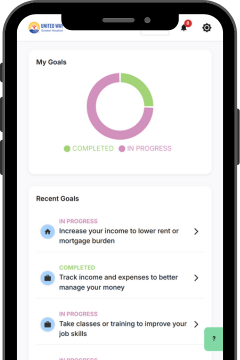
The ICJ Self-Service experience is built around a simple but powerful idea: small, clear actions add up to big moves over time. On the portal, users can choose from goal areas like:
- Career & money moves — employment support, budgeting tools, and pathways toward financial stability
- Health & well-being — physical and mental health resources
- Family & growth — child care, early education, youth programs
- Everyday essentials — food, housing, clothing, and other urgent needs
- Safety & freedom — legal and holistic support to exit unsafe or harmful situations
Each goal leads to tailored next steps and referrals, so the experience doesn’t feel abstract—it feels actionable.

“What’s most exciting for me about Self-Service is probably just being able to provide so many resources to our clients and have it all at their fingertips … A brighter future for themselves, for their family, and for their kids.”
— Shahana Ayobi, Data and Systems Analyst, United Way of Greater Houston
Technology That Reflects Real-World Needs
Behind the scenes, ICJ Self-Service is powered by PCIC’s data and technology infrastructure, built in close partnership with United Way of Greater Houston’s Mission & Strategy and data teams.

“It wouldn't have been possible without the amazing work and dedication of our teams from United Way and PCIC. Our partnership reflects our shared commitment to innovation with purpose. The ICJ Self-Service Portal enables scale and moves us closer to a future where our clients can take ownership of their own well-being. By empowering individuals to access resources and manage their care, we’re helping foster greater self-efficacy — and building stronger, more resilient communities together.”
— Kallol Mahata, Co-Founder & CEO, PCIC
This work sits at the intersection of community expertise and responsible data design:
- United Way brings deep knowledge of ALICE households, local providers, and what actually helps families stabilize.
- PCIC brings experience building secure, interoperable platforms that can scale across agencies while protecting client privacy and meeting strict data-sharing requirements.
The result is not just another website—it’s a coordinated system that keeps client goals, referrals, and progress connected over time.
Innovation With Purpose
For PCIC, ICJ Self-Service is part of a broader commitment to using technology in ways that are grounded in real people’s lives, not just in abstract metrics.

“Our partnership with United Way of Greater Houston redefines how data and technology serve our community - turning complex needs into clear, actionable pathways to stability and self-sufficiency. Together, we’ve built a first-of-its-kind platform that empowers individuals to set goals and connect to resources based on their real-life needs and at their own pace. This community-level solution doesn’t just point to resources - it helps people move forward.”
— Li (Betty) Gai, Sr. Data Analyst & Director of Data Services, PCIC
One month into launch, we’re already seeing what’s possible when community vision, data, and technology pull in the same direction: more inclusive access, more flexible entry points, and more ways for people to move forward on their own terms.
Building for Real Life: PCIC’s Engineering Perspective

“ICJ Self-Service represents the best of collaboration between United Way of Greater Houston’s community vision and PCIC’s technical innovation ... Every design decision—from data flow to user interface—was guided by one question: will this make it easier for someone to take the next step toward stability? ... It’s a great example of how data and design can work together for community impact. Seeing people use something we built to make life a little easier is the most rewarding part.”
— Harshit Dave, Sr. Software Engineer & Development Team Lead, PCIC
From how information moves securely across systems to how buttons, language, and screens are laid out, the engineering work behind ICJ Self-Service is tightly aligned with one goal: reducing friction so that help-seekers can focus on their next step, not on navigating technology.
Grounded in Human-Centered Design: Research Collaboration with Texas Tech University
From the earliest stages of ICJ Self-Service, PCIC and United Way of Greater Houston partnered with a research team from the Technical Communication and Rhetoric program at Texas Tech University (TTU) to ensure that human-centered design was not just a buzzword, but a practice. Through usability testing, diary studies, and interviews with help-seekers and navigators, the TTU team helped us center the lived experiences of people who would actually use the portal—especially those balancing work, caregiving, and financial stress.

“As an outsider, I was thoroughly impressed with the total commitment to enacting human-centered design principles to ensure that participants had an active presence in the design iteration cycle for the app. It was very refreshing to work with industry practitioners who started with questions and concerns about the users’ needs as well as the desire to make sure that any stakeholder participants in any usability study were compensated for their input.”
— Dr. Steve Holmes, Professor of Technical Communication & Rhetoric, TTU
This research partnership helped validate and refine key design decisions—such as plain-language goal categories, step-by-step action plans, and flexible entry points—so that ICJ Self-Service reflects not just what technology can do, but what real users say they need.
What’s Next
Over the coming months, PCIC and United Way of Greater Houston will continue to:
- Learn more about how people are using ICJ Self-Service so we can improve our support
- Understand which goals and resource areas are most in demand so we can co-develop new pathways to financial stability
- Refine the user experience of the ICJ Self-Service portal to better support ALICE households and others facing financial instability through human-centered design
The ICJ Self-Service portal is still new—but the need it responds to is not. As ALICE data continues to show, too many working families in Greater Houston are carrying the burden of instability alone.
With ICJ Self-Service, we’re working alongside United Way of Greater Houston to make big moves to change that—one goal, one connection, and one small win at a time.
Interested in partnering or learning more? Contact PCIC
Related items
- PCIC Launches TACHI Platform with Legacy Community Health to Scale Community Health in Houston’s Greater Northside
- Understanding Recidivism: PCIC’s Ongoing Partnership with Harris County Public Health’s OD2A Team
- Reimagining Care for Vulnerable Populations: A Retrospective on the PCIC and Amerigroup Partnership
- Health & Homelessness in Houston: PCIC Partners with Dr. Ben King of UHCOM to Understand Harris County Homelessness Mortality
- Breaking Down Nutrition Barriers: PCIC and UHCOM Partner to Improve Access to SNAP in Houston’s Third Ward